By Dr. T. Babu Rao
Founder, Provia Global · Executive Director, United Gospel Mission
When Christians talk about the tentmaker model, we usually mean ministry carried alongside ordinary vocational work. The language comes from Acts 18, where Paul worked with Aquila and Priscilla because they shared the same trade.
That example has become especially important for churches and mission leaders asking how ministry can remain faithful when external funding is limited, uncertain, or inappropriate for the context.
But Paul’s example needs to be read carefully. He did not teach that every minister must support himself through a trade, and he did not reject financial partnership. At different points, Paul worked with his hands and also received support from churches. His practice was flexible.
“The tentmaker model is not a rule that ministry must be self-funded. It is a reminder that vocation, stewardship, and mission can sometimes strengthen one another.”
Dr. T. Babu Rao
This article looks at what Paul’s example actually teaches, what it does not teach, and how the tentmaker model can be applied responsibly today.
This article is part of our Sustainable Mission series. For the wider framework, see From Donor Dependency to Sustainable Mission.
What Is the Tentmaker Model?
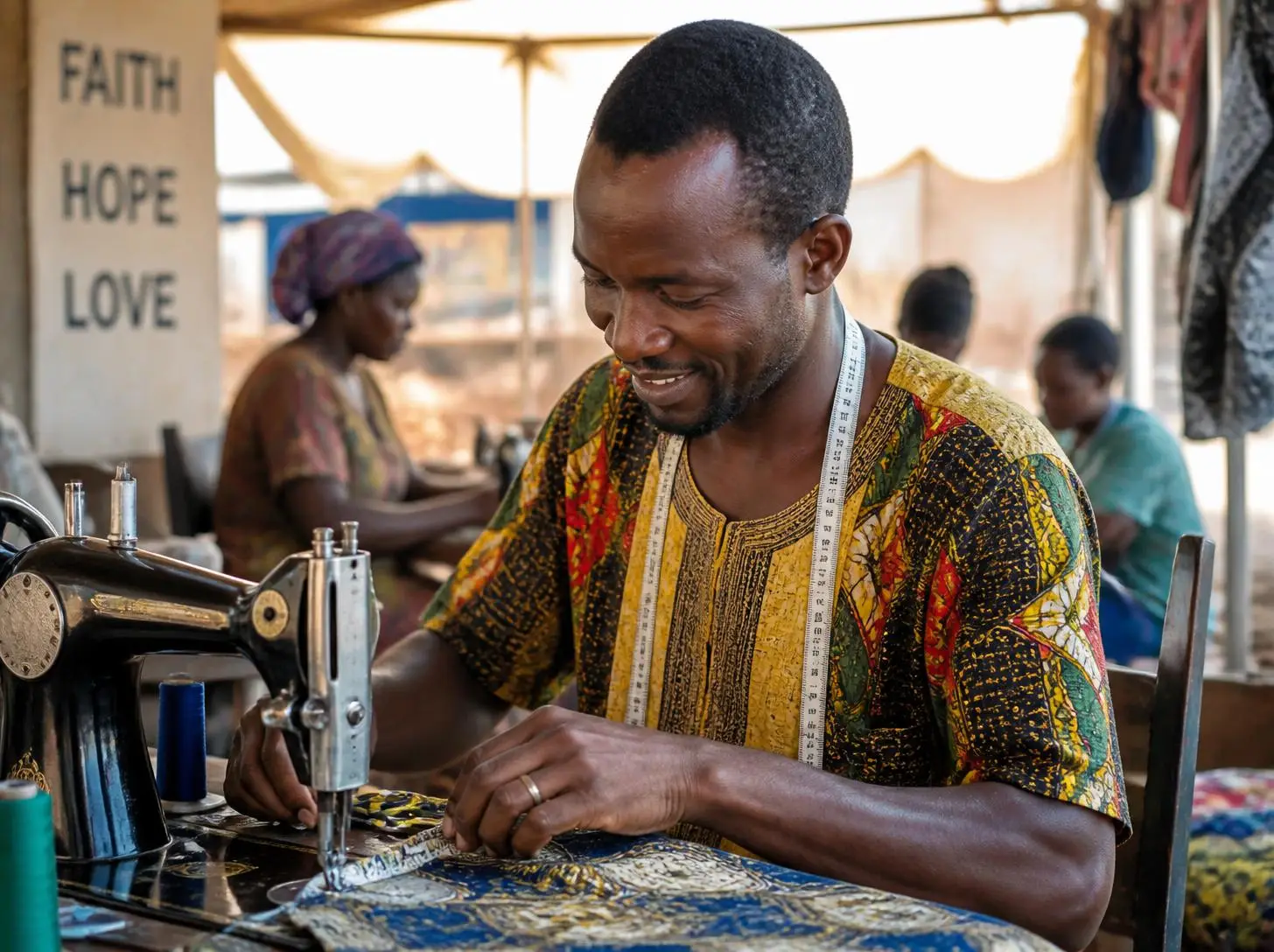
The tentmaker model describes a pattern in which a Christian leader, missionary, church planter, or ministry worker supports some or all of their livelihood through ordinary vocational work while continuing in ministry.
The term itself is modern, but it draws from Acts 18:1–3, where Paul stays and works with Aquila and Priscilla because they share the same trade. Paul’s occupation gave him a means of support and placed him inside the ordinary economic life of the city.
Modern tentmaking can take many forms. A pastor may teach during the week. A church planter may run a small business. A missionary may work in healthcare, education, technology, or a skilled trade. Another leader may combine part-time ministry with professional employment.
The key idea is not “business first” or “ministry second.” It is that vocational work can sometimes provide financial support, social credibility, relationships, and access while ministry continues faithfully.
1. Paul Worked With His Hands—but He Also Received Support
Scripture Focus
Acts 18:3 — Paul stayed and worked with Aquila and Priscilla because they were tentmakers by trade.
Several New Testament passages show Paul working with his hands. In 1 Thessalonians 2:9 and 2 Thessalonians 3:8, he reminds believers that he labored so as not to become an unnecessary burden. In Acts 20:34, he tells the Ephesian elders that his hands supplied his needs and those of his companions.
That is an important part of the tentmaker model.
But it is not the whole picture.
Philippians 4:15–16 records the Philippian church supporting Paul financially. In 2 Corinthians 11:8–9, he also refers to receiving support from other churches while ministering in Corinth. And in 1 Corinthians 9, Paul explicitly defends the right of Gospel workers to receive material support, even though he sometimes chose not to exercise that right.
So Paul’s pattern was not “never accept support.” His pattern was missionally flexible stewardship.
Sometimes working with his hands served the mission best. At other times, receiving partnership support served the mission best.
2. The Tentmaker Model Can Reduce Financial Pressure
One obvious strength of the tentmaker model is that it can reduce dependence on a single funding stream.
A leader who has professional income may be able to continue serving through a season when donations decline. A church planter may have greater freedom to begin ministry without waiting for a full salary package. In contexts where foreign funding is restricted or culturally sensitive, ordinary employment may also make ministry more locally rooted.
But this should not be romanticized.
Bivocational ministry can also create exhaustion. A leader may carry two full workloads. Family time may suffer. Preparation for teaching and pastoral care may become compressed. Financial pressure can remain even when someone is working.
The tentmaker model therefore requires realistic workload planning, healthy boundaries, and a willingness to adjust when the arrangement is no longer sustainable.
3. Work Can Create Natural Relationships and Credibility
Vocational work places Christian leaders in ordinary social and economic environments.
Colleagues, customers, suppliers, students, patients, or clients may encounter a believer first through competent work rather than through a church program. That can create relationships that ministry structures alone may never create.
But vocation should not be treated merely as a strategy for gaining access to people.
Work has value in itself. Christians should serve customers honestly, treat employees justly, keep commitments, and pursue excellence because these are part of faithful discipleship.
The witness of the tentmaker model is strongest when ministry is not hidden behind poor work and work is not exploited merely as a platform.
4. Tentmaking Is Not the Same as Business as Mission
The terms are related, but they are not identical.
Tentmaking usually refers to a ministry worker supporting themselves through employment or a trade. Business as mission generally involves operating a real business that is expected to create economic value while also expressing Christian purpose, witness, and stewardship.
A bivocational pastor employed by a school may be following the tentmaker model without running a business. A company employing fifty people may be practicing business as mission even if its owners are not pastors or missionaries.
Keeping those categories clear is helpful because they involve different responsibilities.
Employment primarily requires faithful professional conduct. Business ownership also involves capital, payroll, taxation, compliance, market risk, governance, and responsibility for employees.
5. Tentmaking Can Strengthen Local Leadership
One of the most useful applications of the tentmaker model is that ministry leadership can grow from within a local economic context rather than depending entirely on outside structures.
A local pastor who also farms, teaches, works in a trade, or runs an enterprise may understand community pressures in a very immediate way. The leader shares some of the same economic realities as the people being served.
This can also make leadership development more reproducible in places where full-time ministry salaries are difficult to sustain.
That does not mean every leader should remain bivocational permanently. Some ministries require full-time pastoral attention, and churches should support leaders appropriately where they are able.
The point is flexibility: the tentmaker model can widen the range of people who are able to serve without making one funding pattern the only legitimate form of ministry.
6. Vocational Skills Can Become Part of Mission Resilience
Vocational training is sometimes discussed as though it were automatically ministry. It is better to be more precise.
Skills training can be extremely valuable when it helps people enter dignified work, improve income, develop a business, or become more economically resilient. But training only helps if the skill connects to real opportunity.
That means vocational initiatives should ask practical questions:
- Is there actual demand for this skill?
- Can participants obtain tools or equipment?
- What does entry into the market require?
- Are wages or margins sufficient to make the work viable?
- Who will provide technical mentoring after training ends?
- What licenses or compliance requirements apply?
The same discipline applies to the tentmaker model. A vocation is not sustainable merely because it sounds useful. It has to work economically in the real context.
7. Tentmaking Does Not Eliminate the Need for Partnership
There is a temptation to present self-support as spiritually superior to donor support. Paul’s own ministry does not allow us to make that argument.
Christian mission is relational. Churches give. Workers receive. Partners share burdens. Leaders sometimes work with their hands. Different seasons call for different arrangements.
A healthy tentmaker model can therefore exist inside a wider funding ecosystem that includes local giving, outside partnership, professional income, and—where appropriate—enterprise income.
The goal is not independence for its own sake. The goal is resilience, accountability, and faithful stewardship.
This is why our wider Sustainable Mission framework emphasizes diversified capacity rather than replacing donors with one new source of income.
8. The Risks of Tentmaking Need to Be Named
The tentmaker model has real strengths, but it also carries risks.
- Burnout: two demanding roles can become unsustainable.
- Divided attention: ministry or professional responsibilities may receive less than they require.
- Ethical compromise: financial pressure can tempt leaders to cut corners in business.
- Role confusion: church authority and business authority can become mixed.
- Hidden expectations: customers or employees may feel pressured spiritually because of the leader’s ministry role.
- Governance problems: church funds and personal business resources can become blurred.
These risks do not invalidate tentmaking. They show why clear boundaries matter.
Business finances should remain distinct from church finances. Employment relationships should not be manipulated for spiritual pressure. Leaders should be accountable for both ministry conduct and professional ethics.
Our article on Biblical Business Ethics explores many of these issues in more detail.
9. How Should a Leader Discern Whether Tentmaking Fits?
The tentmaker model is not right for every leader or every season.
These questions can help:
- Does my vocation provide enough flexibility for the ministry responsibility I carry?
- Is the work economically viable, or will it create additional financial stress?
- What will this arrangement mean for my family and rest?
- Do I have the professional competence required for the work?
- Can church and business finances remain clearly separated?
- Will this strengthen local ministry capacity, or simply overload one leader?
- Would a mixed model of employment, local giving, and partnership support be healthier?
Discernment matters because tentmaking should serve ministry faithfulness rather than become another ideal that leaders feel pressured to imitate.
“The best tentmaking arrangement is not the one that looks most self-sufficient. It is the one that allows a leader to serve faithfully, work ethically, and remain sustainable over time.”
Dr. T. Babu Rao
How Provia Global Is Applying These Principles
The tentmaker model connects with Provia Global’s wider interest in sustainable mission, local leadership, stewardship, and faith-based enterprise.
We are developing the Church-Based Business Accelerator for pilot use as one possible pathway for churches and marketplace believers to explore entrepreneurship education, mentoring, biblical formation, and local economic resilience.
It is important to describe this accurately: the CBA model is still being developed and prepared for pilot implementation. We are not presenting established cohort outcomes.
The CBA is also not simply a tentmaking program. Some participants may be entrepreneurs, some may remain employed professionals, and some church leaders may continue to depend appropriately on congregational or partner support.
The larger goal is to help Christian leaders think more carefully about work, stewardship, enterprise, and local capacity without forcing every context into the same model.
What Paul’s Tentmaking Example Finally Teaches
Paul’s example gives us a valuable pattern, but not a rigid formula.
The tentmaker model reminds us that Christian ministry and productive work can belong together. It shows that leaders may sometimes choose vocational work to reduce financial burden, remain locally embedded, or expand ministry flexibility. It also reminds us that receiving support is not a failure of faith.
The deeper principle is stewardship.
Use the resources, skills, partnerships, and opportunities available in a way that serves the mission faithfully. Work when work serves the calling. Receive support when partnership serves the calling. Do not turn either method into a spiritual status symbol.
If you are exploring the relationship between vocation, enterprise, and ministry sustainability, you may also find Building Sustainable Churches Through Local Enterprise useful.
Dr. T. Babu Rao is the Founder of Provia Global and Executive Director of United Gospel Mission. His work focuses on Christian leadership development, church-based training, sustainable mission, and faith-based entrepreneurship.