
By Dr. T. Babu Rao
Founder, Provia Global · Executive Director, United Gospel Mission
Leadership in business is often discussed in terms of vision, execution, confidence, and results. Those things matter. But biblical business leadership asks an additional question: what kind of person are we becoming as we exercise authority?
A leader can be decisive and still be selfish. A leader can be successful and still make everyone around them weaker. A leader can speak openly about faith while using power in ways that contradict the character of Christ.
That is why I do not think biblical business leadership can be reduced to a list of personality traits. It is about the way authority is understood, the way decisions are made, the way people are developed, and the way a leader remains accountable while carrying real responsibility.
“Biblical business leadership is not leadership without authority; it is authority exercised as stewardship for the good of people and the mission entrusted to us.”
Dr. T. Babu Rao
The goal is not to make Christian leaders passive. It is to help them become strong enough to lead without making the organization revolve around themselves.
On This Page
Explore the sections in this article
What Is Biblical Business Leadership?
Biblical business leadership is the faithful use of authority, influence, and responsibility in business under the lordship of Christ.
It includes competence. Christian leaders should understand their work, make decisions, manage resources, set direction, solve problems, and accept responsibility for outcomes. But Scripture also presses leadership beyond competence toward character, service, justice, humility, truthfulness, and accountability.
That means the central question is not simply, “Can this leader get results?” It is also, “How are those results being achieved, who is being strengthened, and what happens to the organization when the leader is not present?”
This connects closely with our broader discussion of biblical leadership, but business introduces particular pressures: money, ownership, employees, contracts, risk, competition, and the temptation to confuse control with responsibility.
1. Authority Is a Stewardship, Not a Personal Possession
Scripture Focus
“Whoever wants to become great among you must be your servant.” — Mark 10:43
Jesus does not eliminate leadership or authority. He redefines what greatness does with authority.
In business, authority is often necessary. Someone must approve the budget, hire and dismiss, resolve conflict, choose priorities, accept risk, and make difficult calls. Biblical business leadership does not pretend those responsibilities disappear.
But authority becomes dangerous when the leader begins to treat the business, team, or ministry as an extension of personal status.
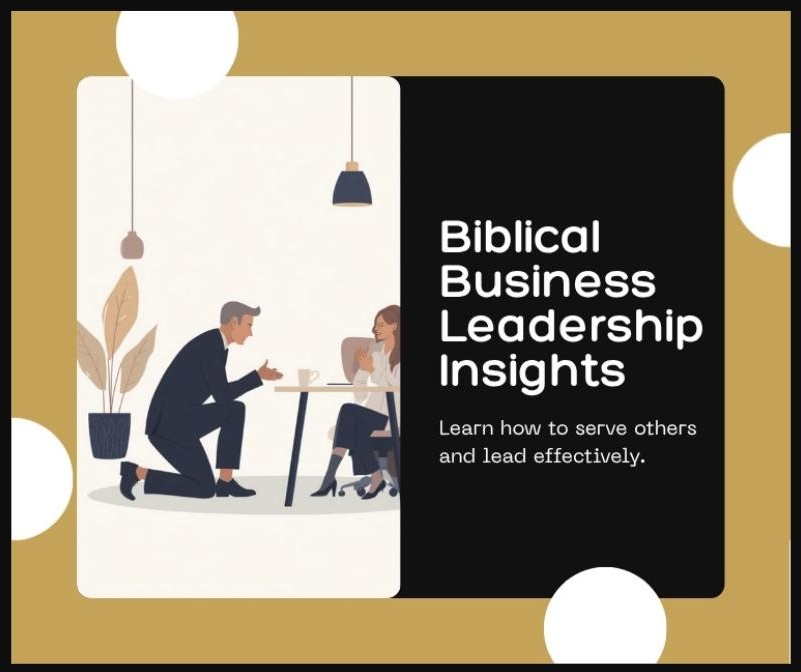
Servant leadership is not simply being agreeable. It means using authority so that people and the mission are strengthened rather than using people to strengthen the leader’s image.
A useful test is to ask: Does my leadership make other people more capable of carrying responsibility, or more dependent on my presence?
2. Service Does Not Mean Avoiding Hard Decisions
One reason servant leadership is sometimes misunderstood is that service can sound passive. Business leaders know that delay can be costly. Sometimes a decision must be made before everyone agrees.
Scripture does not require leaders to surrender judgment every time a difficult choice appears.
Nehemiah is a helpful example. He organized people, assigned work, responded to threats, confronted economic exploitation, and made decisions under pressure. At the same time, Nehemiah 5 records that he refused to use his position as governor in the same exploitative way as those before him.
The lesson is not that every Christian leader should imitate Nehemiah’s exact methods. It is that decisiveness and service are not opposites.
Biblical business leadership can say “no,” set standards, correct poor performance, restructure a team, or close an unviable project. The question is whether those decisions are made truthfully, fairly, and with a willingness to bear responsibility for their consequences.

3. Listening Is Part of Leadership, Not a Threat to It
Leaders often feel pressure to appear certain. But confidence that never listens can become blindness.
Proverbs repeatedly connects wisdom with counsel. Listening does not mean a leader must follow every suggestion. It means the leader has created enough space for information, correction, and disagreement to reach the decision-making process.
In practical terms, biblical business leadership should make it possible for an employee to raise a concern, for a financial adviser to challenge an assumption, or for a colleague to say that a decision may be moving too quickly.
One of the most dangerous environments is a leadership culture where everyone knows what the leader wants to hear.
That is why I value people who can disagree respectfully. A leader who has authority but no one who can challenge that authority is operating with unnecessary risk.
4. Develop People, Not Merely Delegated Tasks
Scripture Focus
“Entrust to reliable people who will also be qualified to teach others.” — 2 Timothy 2:2
Delegation is not the same as leadership development.
A leader can delegate a great deal while still keeping all meaningful judgment at the center. Someone else prepares the report, but the leader interprets it. Someone else manages the schedule, but the leader makes every decision. Someone else carries responsibility in name, but has no authority to act.
Biblical business leadership should gradually prepare trustworthy people to carry real responsibility.
That requires more than assigning tasks. Emerging leaders need context, authority appropriate to their role, feedback, room to make some decisions, and the opportunity to learn from mistakes that are not catastrophic.
“If every important decision still has to return to the founder, delegation may have increased while leadership has not multiplied.”
Dr. T. Babu Rao
This does not mean every employee must become a senior leader. It means a healthy organization should not deliberately keep capable people dependent simply because the founder finds control reassuring.

5. Accountability Should Increase With Authority
As leaders gain influence, they often gain more privacy around their decisions. Fewer people see the full picture. More employees depend on their judgment. Financial decisions become larger. The consequences of mistakes become wider.
That is exactly when accountability should become stronger, not weaker.
Biblical business leadership should include appropriate financial controls, documented approvals, conflict-of-interest disclosure, trusted advisers, and governance that does not disappear simply because the founder is respected.
Accountability is not a statement that a leader is untrustworthy. It is recognition that no leader is beyond self-deception, pressure, fatigue, or poor judgment.
Our article on Biblical Business Ethics explores this further. Character matters, but healthy systems help character remain visible and reviewable.
6. Employees Are People to Develop, Not Inputs to Consume
Businesses need productivity. Roles have expectations, deadlines matter, and performance should be evaluated honestly.
But Christian leadership should resist reducing people to units of output.
Employees have families, limits, aspirations, responsibilities, strengths, and weaknesses. That does not remove performance standards; it changes the way those standards are carried.
Biblical business leadership should therefore affect how leaders give feedback, handle mistakes, set workloads, recognize contribution, resolve conflict, and make termination decisions.
A difficult conversation can still preserve dignity. A performance problem can be addressed without humiliation. A termination can be necessary without becoming vindictive.
The deeper question is whether people who work under our authority are being treated as persons made in God’s image or merely as resources whose value ends when their output declines.
7. Success Should Be Measured Beyond the Founder
Founders understandably identify strongly with what they build. In the early stages, the founder may carry vision, sales, operations, relationships, and finances almost alone.
That can be necessary for a season. It becomes a weakness when the business never grows beyond it.
A healthy leader begins asking: Who else understands the mission? Who can make decisions? Who knows the customer? Who can manage finances? Who can carry key relationships? What happens if I am unavailable for a month?
This is where biblical business leadership and stewardship meet. The organization itself is something entrusted to us. Building it so that everything permanently depends on one person is usually not the strongest stewardship of that responsibility.
Succession does not mean the founder is trying to leave immediately. It means the leader is building depth before a crisis forces the issue.
8. Humility Means Remaining Teachable When You Are Successful
Scripture Focus
“Pride goes before destruction, a haughty spirit before a fall.” — Proverbs 16:18
Failure can make leaders teachable because the need for help is obvious. Success creates a different danger: it can make previous good decisions feel like evidence that future decisions no longer need scrutiny.
That is why success can be one of the most demanding tests of biblical business leadership.
Growth brings praise, influence, opportunities, and often greater control over resources. A leader must learn to receive success without converting it into immunity from correction.
I would rather see a successful leader asking better questions than defending a reputation for always having the answer.
Humility is not pretending we have no competence. It is recognizing that competence does not make us infallible.
A Practical Biblical Business Leadership Review
For founders, executives, ministry leaders, and leadership teams, these questions can help expose where leadership may be becoming too dependent on one person:
- Which important decisions can only I make, and which of those could responsibly be entrusted to someone else?
- Who is free to challenge me without fear of losing access or opportunity?
- Do people understand the reasons behind decisions, or only the instructions?
- Are emerging leaders receiving meaningful responsibility or only additional tasks?
- Do our financial and governance systems become stronger as the organization grows?
- How do I respond when someone identifies a mistake in my judgment?
- Are employees becoming stronger through my leadership, or more dependent?
- If I were unavailable for several weeks, where would the organization immediately become fragile?
The purpose is not to eliminate the founder or weaken leadership. It is to identify where responsibility has become unnecessarily concentrated.
How This Connects With Provia Global
These convictions shape Provia Global’s wider approach to leadership development and the Church-Based Business Accelerator model we are developing for pilot use.
We are not claiming established CBA cohort outcomes. The model is being designed around the conviction that entrepreneurs need more than business technique. They also need formation in stewardship, ethics, accountability, leadership, and the ability to develop others.
That connects directly with our articles on Christian Business Principles and Biblical Business Ethics. Together, they address different parts of the same question: how should Christian conviction shape the way an enterprise is actually led?
What Biblical Business Leadership Finally Looks Like
Biblical business leadership is not weakness dressed up as service. Nor is it conventional command-and-control leadership with Bible verses added afterward.
It is the disciplined use of authority as stewardship.
It means serving without abandoning responsibility, listening without surrendering judgment, developing people without avoiding standards, building accountability before a crisis, and preparing the organization to become stronger than the founder’s personal capacity.
Christian leaders will still make hard calls. Some decisions will disappoint people. Some risks will fail. But the goal is to exercise authority in a way that reflects the character of Christ and leaves people, systems, and future leaders stronger.
If you want to explore Provia Global’s wider approach, see our leadership development work or connect with us.
Dr. T. Babu Rao is the Founder of Provia Global and Executive Director of United Gospel Mission. His work focuses on Christian leadership development, church-based training, sustainable mission, and faith-based entrepreneurship.
Related Reading: This is one of seven core commitments outlined in our companion guide, Biblical Principles for Business — see how servant leadership fits alongside stewardship, integrity, and generosity as a foundation for Christian enterprise.