

By Dr. T. Babu Rao
Founder, Provia Global · Executive Director, United Gospel Mission
The language of servant leadership is now common in churches, ministries, nonprofits, workplaces, and even corporate leadership. The difficulty is that a phrase can become familiar long before its demands become personal.
For me, servant leadership becomes meaningful when it moves beyond the question, “Do I believe leaders should serve?” and reaches the harder questions: How do I use authority? What happens when serving costs me convenience, recognition, or control? Are the people around me becoming stronger, or simply more dependent on me?
Biblical servant leadership is the Christ-shaped use of God-given authority to serve, strengthen, protect, and develop the people entrusted to us. That is the heart of the servant leadership meaning presented in Scripture. When we ask, “What is servant leadership?” the biblical answer does not remove authority; it redirects authority away from self-advancement and toward the good of others, the fulfilment of the mission, and the glory of God.
Jesus did not present service as the opposite of leadership. He presented it as the way Christian leadership should use power. Servant leadership is not passive leadership, weak leadership, or leadership without authority. It is authority deliberately placed at the service of others.
“Servant leadership is not leadership without authority; it is authority placed at the service of others.”
Dr. T. Babu Rao
What Is Servant Leadership?
Scripture Focus
Matthew 20:25–28 (NIV) — Whoever wants to become great among you must be your servant … just as the Son of Man did not come to be served, but to serve.
In Matthew 20, Jesus begins by describing rulers who “lord it over” people and officials who use authority to make their power felt. Then He gives His disciples a direct correction: “Not so with you.” Christian leadership cannot simply borrow the world’s understanding of greatness and add religious language to it. Jesus redefines greatness through service and places His own life at the centre of that definition.
The parallel account in Mark 10:42–45 gives the same kingdom pattern: the one who would be first becomes the servant of all, following the Son of Man who came not to be served but to serve and to give His life for many.
At its simplest, servant leadership means using leadership responsibility for the good of the people entrusted to us rather than using people primarily to strengthen our own position. The issue is not whether authority is exercised, but what that authority is for.
Jesus Is the Primary Model of Biblical Servant Leadership
Scripture Focus
John 13:1–17 (NIV) — I have set you an example that you should do as I have done for you.
John 13 is one of the clearest pictures of servant leadership in the Bible because Jesus serves from a position of authority, not from the absence of it. John tells us that Jesus knew who He was, knew where He had come from, and knew that the Father had placed all things under His power. It is in that context that He takes the towel, washes His disciples’ feet, and tells them to follow His example.
That matters. The lesson is not that power itself is wrong. The lesson is that power can be used in a way the world does not expect. Jesus remains their Lord and Teacher while performing the work of a servant. His service does not deny His authority; it reveals the purpose and character of that authority.
Paul develops the same pattern in Philippians 2:5–8. Christ does not cling to status for personal advantage. He moves toward obedience, humility, and sacrifice. Matthew 20 gives us His teaching, John 13 gives us His enacted example, and Philippians 2 shows us the mind and self-giving obedience beneath it. Christian servant leadership begins there.
What Servant Leadership Is Not
Because the language of service can be misunderstood, it is important to say clearly what biblical servant leadership is not. It is not passivity, people-pleasing, weakness, avoidance of conflict, lack of boundaries, or refusal to exercise authority and accountability.
A servant leader may need to make an unpopular decision, correct harmful behaviour, protect the mission, confront misuse of power, or say no when expectations have become unhealthy. Jesus could be compassionate and confrontational, patient and decisive. Serving people does not mean allowing every preference to direct the organization or permitting damaging conduct to continue.
Servant leadership also does not mean that a leader must personally do every task. Doing everything can become another form of control because it prevents others from growing and keeps responsibility centred on one person. Nor does service require a leader to accept abuse or remain indefinitely in a destructive system. Biblical service is not the destruction of the servant. Healthy service includes truth, responsibility, wise boundaries, and accountability.
Seven Biblical Servant Leadership Characteristics
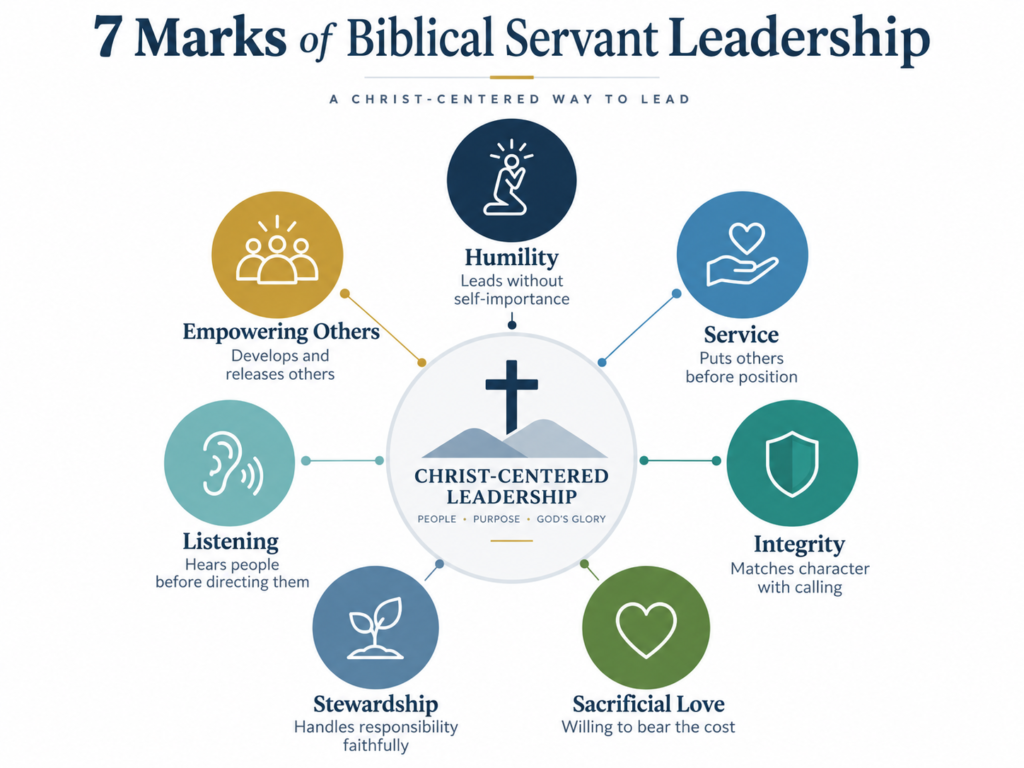
The language used to describe servant leadership traits can vary, but seven characteristics provide a clear framework for examining how a Christian leader serves and uses authority. The servant leader Bible verses accompanying these marks are not isolated slogans; together they show how service, character, responsibility, and love belong to one Christ-centred pattern of leadership:
- Service — putting the good of others before position or recognition.
- Humility — using authority without self-importance.
- Listening — hearing people seriously before directing them.
- Empowering Others — developing people and releasing real responsibility.
- Stewardship — handling authority, resources, and responsibility faithfully.
- Integrity — aligning character, words, decisions, and conduct.
- Sacrificial Love — remaining willing to bear a genuine cost for the good of others.
1. Service: A Servant Leader Serves Before Expecting to Be Served
Galatians 5:13 (NIV) — Serve one another humbly in love.
Service becomes credible when it is more than an occasional gesture. A servant leader notices what people need, removes unnecessary obstacles, and is willing to take responsibility for work that may never attract attention.
This does not mean the leader must personally do every task. The deeper issue is whether the leader sees service as beneath the role or as part of the role. In ministry, I have found that people usually recognize the difference between leaders who talk about service and leaders whose habits have quietly demonstrated it over time.
2. Humility: Authority Is Used Without Self-Importance
1 Peter 5:2–3 (NIV) — Not lording it over those entrusted to you, but being examples to the flock.
Humility does not require a leader to pretend that leadership responsibility does not exist. Peter speaks directly to people with real responsibility and tells them not to “lord it over” those entrusted to them.
Position should never become the main argument for why people must follow. Titles may clarify responsibility, but character, example, competence, and trust determine whether influence becomes healthy. A humble leader can still make a firm decision. Humility is shown in how that decision is made, how people are treated, whether correction can be received, and whether the leader remains accountable.
3. Listening: Servant Leaders Listen Before They Decide
James 1:19 (NIV) — Everyone should be quick to listen, slow to speak and slow to become angry.
Leadership sometimes requires decisions before complete agreement is possible. But there is a difference between deciding without consensus and deciding without listening.
I have seen situations in ministry where the problem was not a lack of vision. The problem was that a decision moved too quickly for the people most affected to be heard. Listening does not guarantee that everyone gets what they want. It does help ensure that people are treated as participants rather than obstacles.
One practical signal for a leader is silence. If people around us stop bringing concerns, that may not mean everything is healthy. It may mean they no longer believe speaking honestly will make a difference.
4. Empowering Others: Servant Leaders Develop and Release People
2 Timothy 2:2 (NIV) — Entrust to reliable people who will also be qualified to teach others.
Paul’s instruction to Timothy gives us a multiplication pattern: what has been received is entrusted to others who can then entrust it again. This moves leadership beyond personal productivity. A leader may achieve impressive results and still leave behind a fragile system if nobody else has been prepared to carry responsibility.
Moses provides a similar lesson in Exodus 18. His problem was not unwillingness to work; he had allowed too much responsibility to remain centred on himself. Jethro’s counsel was not merely delegation for efficiency. Capable people were identified, authority was entrusted, and responsibility was distributed more healthily.
I believe this is one of the strongest tests of servant leadership: does a leader use authority to make others increasingly capable, or increasingly dependent? This connects closely with our broader work in faith-based leadership development. Leadership development becomes real when responsibility is actually entrusted, not merely discussed.
“A leader has not multiplied well if everything still depends on that leader being present.”
Dr. T. Babu Rao
For me, one of the most important questions at the end of a season of leadership is not simply, “What did we accomplish?” but also, “Who became stronger? Who can now carry responsibility that they could not carry before?”
5. Stewardship: Authority and Responsibility Are Handled Faithfully
1 Corinthians 4:2 (NIV) — Those who have been given a trust must prove faithful.
A servant leader understands that authority, influence, money, opportunities, information, and organizational responsibility are entrusted rather than owned. Stewardship asks not only, “What am I permitted to do?” but also, “What would faithfulness require from me?”
Healthy leaders are usually generous with credit and careful with blame. That does not mean every failure should be hidden or that individual accountability disappears. It means the leader accepts responsibility for the system, the clarity of expectations, the quality of preparation, and the environment in which people are working.
David’s decision in 1 Samuel 30:21–25 offers a useful picture. He refused to let those who remained with the supplies be treated as less valuable than those who went into battle. Public recognition should move outward whenever possible. Correction should usually become more personal and private as it becomes more specific.
6. Integrity: Character, Words, and Decisions Remain Aligned
Titus 2:7–8 (NIV) — In everything set them an example by doing what is good.
Service without integrity eventually becomes performance. A leader may speak humbly in public and still use people carelessly in private. Biblical integrity requires consistency between our teaching, promises, financial decisions, treatment of people, and willingness to be accountable.
In ministry and nonprofit leadership, integrity becomes visible in practical places: how accurately we report results, how carefully we handle funds, whether donor expectations are represented honestly, whether staff and partners receive clear information, and how we respond when plans do not succeed as expected. Character is not an addition to leadership credibility; it is part of its foundation.
Integrity also makes correction safer. A leader who admits mistakes, keeps appropriate records, welcomes oversight, and applies standards fairly creates an environment where accountability serves restoration and mission rather than personal control.
7. Sacrificial Love: Service Remains Faithful When It Costs Something
1 Corinthians 9:19 (NIV) — Though I am free and belong to no one, I have made myself a slave to everyone, to win as many as possible.
Service is easiest when it is appreciated. The deeper test comes when service is inconvenient, misunderstood, unnoticed, or costly. Paul’s language is deliberately strong. He describes choosing limitation for the sake of others and for the advance of the gospel.
Sacrificial love does not mean ignoring the boundaries already discussed or remaining in an abusive system. It means Christian leaders cannot make applause, comfort, or personal advantage the measure of whether service is worthwhile. Some of the most important acts of leadership will never become public stories.
Jesus remains the final measure. His servant leadership leads from the towel in John 13 to the self-giving obedience described in Philippians 2 and to the ransom language of Matthew 20:28. Christian service is not merely courteous behaviour; it is love willing to bear a real cost for the good of others.
How Servant Leadership Relates to Other Leadership Styles
I do not think servant leadership should be treated as one leadership style sitting beside several completely separate styles. A Christian leader may sometimes need to be highly directive, sometimes collaborative, sometimes visionary, and sometimes corrective. The servant question remains underneath all of them: What is this authority being used for?
An authoritative decision can still be servant-hearted if it protects people, preserves mission, and is made responsibly. A collaborative process can still be self-serving if a leader uses participation only to avoid responsibility. So the contrast is not simply “servant leadership versus strong leadership.” Servant leadership asks strong leadership to become accountable for the purpose of its strength.
Examples of Servant Leadership in the Bible
When people search for servant leadership examples, Scripture gives us more than one personality or leadership method. These examples of servant leadership in the Bible show different ways authority can be directed toward the good of others:
- Jesus, the definitive example — In Matthew 20:25–28, John 13:1–17, and Philippians 2:5–8, Jesus teaches, demonstrates, and embodies servant leadership. He uses authority to serve and ultimately gives Himself for others.
- Moses receiving counsel and sharing responsibility — In Exodus 18:13–26, Moses listens to Jethro, identifies capable leaders, and releases meaningful responsibility instead of keeping every decision centred on himself.
- Barnabas standing beside Saul — In Acts 9:26–28, Barnabas uses his personal credibility to create space for another person when others remain afraid and uncertain.
- Nehemiah refusing to exploit his office — In Nehemiah 5:14–18, Nehemiah does not use the governor’s privileges to burden the people. He accepts the responsibility of leadership without extracting every advantage available to him.
- Paul serving through work, teaching, and sacrifice — In Acts 20:33–35, Paul reminds the Ephesian elders that he worked, helped the weak, and demonstrated the generosity he taught. His example shows that service is not one financial formula; it is the willingness to arrange our choices around the good of the mission and the people being served.
For a fuller set of leadership profiles, see Leaders in the Bible: 8 Profiles Every Christian Leader Should Study.
How Servant Leadership Works in Church, Nonprofit, and Workplace Settings
The principles of biblical servant leadership do not change when the setting changes, but their practical expression may look different. In my ministry and nonprofit experience, the same questions about authority, listening, stewardship, integrity, and the development of people appear across several contexts.
Church and Ministry Leadership
In the church, servant leadership means shepherding people rather than building dependence on a personality. It includes teaching faithfully, addressing harmful conduct, listening to local leaders, developing younger workers, and releasing responsibility. A pastor or ministry leader serves the congregation not by avoiding difficult leadership but by exercising it for the spiritual health and maturity of the body.
Nonprofit and Mission Leadership
In a nonprofit, leaders carry responsibility for mission, staff, volunteers, donors, partners, beneficiaries, and resources. Servant leadership requires clear governance, honest communication, responsible financial stewardship, and attention to how organizational decisions affect the people closest to the work. It also means that protecting the mission may sometimes require saying no, correcting a process, or setting a boundary.
Organizational and Workplace Leadership
In the workplace, servant leadership can be seen when leaders listen before deciding, establish fair expectations, give people the tools and authority needed to succeed, share credit, accept responsibility, and address problems without humiliating people. The workplace is not a church, but Christian leaders can still bring a Christ-shaped understanding of authority into how they supervise, decide, correct, and develop others.
Biblical Servant Leadership and the Modern Term
The modern management term servant leadership is closely associated with Robert K. Greenleaf, particularly his 1970 essay The Servant as Leader. His work gave the concept a vocabulary that later became influential in organizational leadership.
For Christian leaders, however, the foundation goes much deeper than a modern management model. Greenleaf can be useful to read, but Scripture gives biblical servant leadership its theological centre: Christ’s character, Christ’s use of authority, Christ’s sacrifice, and Christ’s call to His followers.
Our broader guide to biblical leadership places servant leadership alongside character, accountability, calling, stewardship, and the development of others.
Questions I Would Ask a Leadership Team
Servant leadership becomes easier to discuss when we move from ideals to concrete questions:
- What has our leadership recently made easier for the people we lead?
- Where are decisions still concentrated unnecessarily in one person?
- Do people have a safe way to disagree with us?
- Who is becoming more capable because we entrusted them with real responsibility?
- Are we generous with credit and responsible with blame?
- Are our words, reports, financial decisions, and private conduct aligned?
- What part of our leadership depends too heavily on title or position?
- If the present leader stepped away, what would become stronger, and what would immediately become fragile?
These questions are not meant to produce a flattering self-assessment. They are meant to reveal whether service has actually entered the structure of the way we lead.
What Servant Leadership Finally Comes Down To
Servant leadership is not the absence of ambition, authority, or strength. It is a different answer to the question of what leadership is for. Jesus did not call His disciples to become less responsible. He called them to use responsibility differently.
That means serving before demanding service, leading with humility, listening seriously, empowering others, stewarding responsibility, walking in integrity, and remaining faithful in sacrificial love when service is costly.
At Provia Global, this conviction shapes how we think about leadership formation. Our concern is not only whether a leader can accomplish a task, but whether that leader is developing the character and the people required for ministry to remain healthy over time. You can explore that wider approach on our What We Do page.
Related reading: What Is Biblical Leadership?, Raising Leaders Who Last, and Leaders in the Bible.
Frequently Asked Questions About Servant Leadership
What does servant leadership mean?
Servant leadership means using leadership authority for the good, growth, and protection of the people entrusted to you rather than using people primarily to strengthen your own position. In biblical servant leadership, Jesus is the definitive model.
What are the main characteristics of a servant leader?
The seven servant leadership characteristics developed in this article are service, humility, listening, empowering others, stewardship, integrity, and sacrificial love. These traits shape both what a servant leader does and how authority is exercised.
Is servant leadership weak leadership?
No. Servant leadership can be decisive, corrective, strategic, and strong. It is not passivity or people-pleasing. The difference is that authority is exercised responsibly for the good of people and the mission rather than primarily for the leader’s personal advantage.
What are examples of servant leadership in the Bible?
Jesus washing His disciples’ feet and giving His life is the definitive example. Moses sharing responsibility, Barnabas advocating for Saul, Nehemiah refusing to exploit his office, and Paul serving through work, teaching, and sacrifice are additional biblical examples.
What did Jesus teach about servant leadership?
In Matthew 20:25–28, Jesus rejected leadership built on domination and taught that greatness in His kingdom is expressed through service. In John 13:1–17, He demonstrated that teaching by washing His disciples’ feet while remaining their Lord and Teacher.
How can servant leadership be practiced in the workplace or nonprofit sector?
It can be practiced by listening before deciding, setting clear expectations, protecting people and mission, sharing credit, accepting accountability, developing colleagues, using resources faithfully, and making difficult decisions without treating people as instruments.
Who popularized the modern term servant leadership?
Robert K. Greenleaf popularized the modern organizational term through his 1970 essay The Servant as Leader. Christian teaching on servant leadership, however, is rooted much earlier in Scripture and especially in the life and teaching of Jesus.
Dr. T. Babu Rao is the Founder of Provia Global and Executive Director of United Gospel Mission. His work focuses on Christian leadership development, church-based training, sustainable mission, and faith-based entrepreneurship.