
By Dr. T. Babu Rao
Founder, Provia Global · Executive Director, United Gospel Mission
Every ministry leader eventually has to ask a difficult question: what happens if a major source of funding changes, pauses, or ends?
That question is not an argument against donors. Christian mission has always depended on generosity, partnership, hospitality, shared resources, and people giving so that others can serve. The question is whether a ministry has become so dependent on one outside source that its core work cannot continue without it.
That is where sustainable mission becomes important. I use the term to describe ministry that is increasingly resilient, locally owned, responsibly governed, and supported by a healthy mix of resources rather than remaining permanently vulnerable to one donor, one leader, or one outside organization.
“Sustainable mission is not donor-free mission. It is ministry in which partnership strengthens local capacity instead of quietly replacing it.”
Dr. T. Babu Rao
What is sustainable mission?
Sustainable mission is ministry that can continue faithfully because leadership, stewardship, governance, finances, and local ownership are becoming stronger over time. It does not mean rejecting donors or outside partnerships; it means reducing unhealthy dependence on any single source of support.
Does the Bible require ministries to become financially self-sufficient?
No single funding model is prescribed for every ministry. Paul sometimes worked with his own hands and at other times received financial support from partner churches. The biblical emphasis is faithful stewardship, generosity, responsibility, and avoiding patterns that undermine local maturity or accountability.
How can churches diversify mission funding responsibly?
Depending on context, a ministry may combine local giving, multiple donor partnerships, prudent reserves, cost discipline, grants, and earned or enterprise income where appropriate. The right mix differs by ministry; diversification should strengthen mission rather than turn the church into a commercial institution.
What are signs that a ministry is becoming more sustainable?
Useful signs include stronger local leadership, transparent budgeting, more than one funding source, healthy reserves where possible, growing local participation, documented governance, and the ability to continue core ministry when one source of funding changes.
How does Provia Global connect enterprise with sustainable mission?
Provia Global is developing its Church-Based Business Accelerator for pilot use as one possible pathway for faith-based enterprise, entrepreneurship education, stewardship, mentoring, and local economic resilience. Enterprise is presented as one option where appropriate, not as a universal funding formula for churches.
On This Page
Explore the sections in this article
What Does Sustainable Mission Actually Mean?
Sustainable mission is not the same as financial independence. Few healthy ministries are completely independent, and independence itself is not a biblical virtue. The New Testament shows churches giving to one another, missionaries receiving support, believers sharing resources, and partnerships extending the reach of ministry.
The problem is not partnership. The problem is fragility.
A ministry becomes fragile when too much depends on one donor, one founding leader, one outside organization, or one funding cycle. A more sustainable ministry gradually develops stronger local leadership, clearer governance, wider participation, financial transparency, diversified resources, and the ability to adapt when circumstances change.
In other words, sustainable mission is about resilience and biblical stewardship, not about proving that we no longer need anyone else.
1. Partnership Is Biblical—Dependency Is the Question
It is easy to overcorrect when talking about donor dependency. Paul worked with his own hands in places such as Corinth, but he also received financial support from churches. Philippians 4 records a genuine partnership in giving and receiving. In 2 Corinthians 11, Paul also speaks of receiving support while serving elsewhere.
So Paul’s tentmaking should not be used to teach that “real” ministry never accepts outside funding.
The better question is: What is this partnership producing?
- Is outside funding strengthening local leadership or replacing it?
- Is it helping a ministry build systems, skills, and accountability?
- Does the local church participate in giving and decision-making?
- Would the ministry become stronger or weaker if the donor relationship changed?
- Are expectations transparent on both sides?
A healthy donor relationship can be a major part of sustainable mission when it builds capacity rather than creating permanent passivity.
2. Paul’s Tentmaking Shows Flexibility, Not a Single Funding Formula

Acts 18 tells us that Paul worked as a tentmaker. That matters because it shows that productive work and Gospel ministry are not enemies.
But Paul’s wider ministry also shows flexibility. At times he worked; at times churches supported him; at times he deliberately refused support in a particular context. His funding practice served the mission rather than becoming an inflexible rule.
That is an important principle for sustainable mission. Different ministries may need different combinations of local giving, outside partnership, bivocational leadership, grants, reserves, or earned income. The goal is not to copy one mechanism but to develop a funding pattern that supports faithful ministry without creating unnecessary dependence.
For a deeper look at Paul’s vocational example, see The Tentmaker Model: Lessons from Apostle Paul.
3. Local Giving Is Part of Discipleship, Not Just Budgeting
One of the healthiest shifts a ministry can make is to treat local generosity as part of Christian formation rather than something discussed only during a shortfall.
That does not mean pressuring people to give beyond their means. New Testament generosity is repeatedly connected with willingness, grace, and proportionate participation.
When believers learn to contribute financially, serve with their skills, open their homes, volunteer time, and carry responsibility, local ownership grows in more than one dimension.
“Local ownership begins before a ministry can pay all of its own bills. It begins when local believers increasingly carry responsibility for the mission.”
Dr. T. Babu Rao
This is a central part of sustainable mission: people are not merely recipients of ministry; they become participants in carrying it.
4. Local Enterprise Can Help—But It Is Not the Answer Everywhere
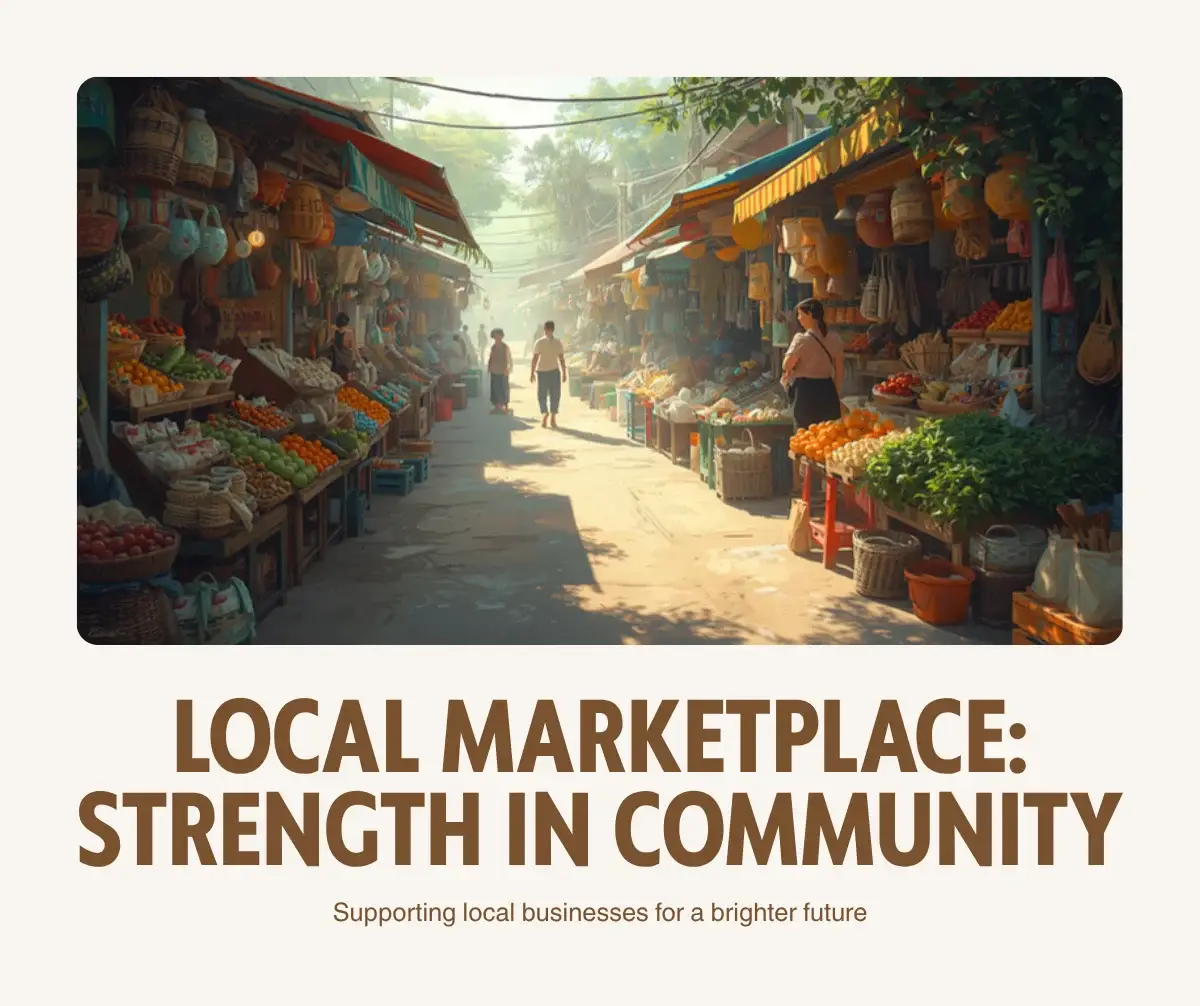
Enterprise can strengthen economic resilience when it fits the context. A church member may develop a business. A ministry may operate an appropriate earned-income activity. A group of participants may form a cooperative. A bivocational leader may support ministry through professional work.
But I would be cautious about telling every church to start a business.
Commercial activity creates real responsibilities: market risk, capital requirements, taxation, accounting, legal compliance, staff management, competition, and the possibility of loss. A ministry should not enter business simply because donor funding feels uncertain.
Enterprise belongs inside a sustainable mission strategy only where there is genuine opportunity, competent leadership, appropriate governance, and clear separation between ministry finances and commercial decisions.
Our article on Church-Led Economic Development explores this distinction further.
5. Local Leadership Matters as Much as Local Money
A ministry can diversify its funding and still remain dependent if all important decisions continue to come from one founder or outside partner.
That is why leadership development belongs at the center of sustainable mission.
Paul’s instruction in 2 Timothy 2:2 describes a pattern of entrusting responsibility to reliable people who can teach others. The principle is multiplication: ministry becomes more resilient when knowledge, authority, and responsibility can be carried by more than one person.
Local leaders also bring language, relationships, cultural understanding, credibility, and continuity that cannot simply be imported.
This does not mean outside leaders have nothing to contribute. It means their contribution should increasingly strengthen the capacity of people who will remain when the outside partner is no longer present.
See our guide to Faith-Based Leadership Development for more on building leadership depth.
6. Build a Funding Ecosystem, Not a Single Replacement Source
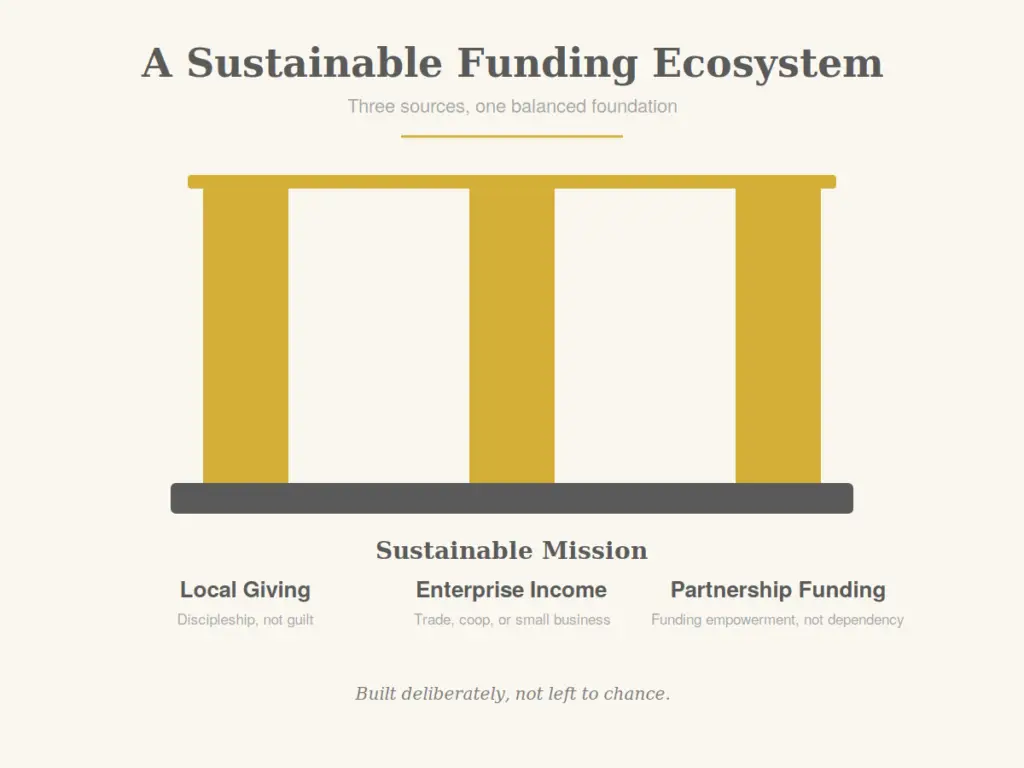
The goal of sustainable mission should not be to replace one dependency with another.
For example, a ministry that moves from one foreign donor to one church-owned business may still be fragile if that business becomes the sole source of support.
A healthier funding ecosystem may include several of the following, depending on context:
- Local giving developed through discipleship and voluntary generosity;
- Multiple donor or church partnerships rather than overreliance on one funder;
- Prudent reserves where resources allow;
- Grants for defined projects, capacity building, or innovation;
- Bivocational or professional income for some leaders where appropriate;
- Earned or enterprise income where there is a viable business case;
- Cost discipline and transparent budgeting so growth in income is not cancelled by uncontrolled expansion.
No ministry needs every item on this list. The mix should fit its mission, legal context, scale, and leadership capacity.
7. Governance Is Part of Sustainability
Financial sustainability without accountability can create new problems.
As resources diversify, ministries need clear budgets, documented approvals, appropriate segregation of duties, conflict-of-interest practices, reliable accounting, and leadership teams that understand the financial position of the organization.
This is sometimes overlooked because governance feels less inspiring than fundraising or entrepreneurship. Yet weak systems can undo years of good work.
Sustainable mission requires both spiritual faithfulness and organizational responsibility.
How Do You Know a Ministry Is Becoming More Sustainable?
Sustainability is not a finish line, and I would be cautious about creating one universal percentage of “local funding” that every ministry must reach.
Better questions include:
- Would the ministry continue its core work if one donor relationship ended?
- Is funding becoming more diversified over time?
- Are local believers increasingly participating in giving, service, and decision-making?
- Are emerging leaders being entrusted with real responsibility?
- Does the ministry understand its true operating costs?
- Are reserves or contingency plans developing where possible?
- Are donors funding capacity as well as activities?
- Are important decisions increasingly made close to the people the ministry serves?
- Are accounting, governance, and reporting becoming stronger as resources grow?
These questions give a more realistic picture of sustainable mission than simply asking whether outside funding has disappeared.
How Provia Global Is Approaching Sustainable Mission
At Provia Global, this theme connects with our wider interest in leadership development, stewardship, church capacity, and faith-based enterprise.
We are developing the Church-Based Business Accelerator for pilot use as one possible pathway for entrepreneurship education, mentoring, character formation, and local economic resilience.
It is important to state this accurately: the CBA model is still being developed and prepared for pilot implementation. We are not presenting a mature network of cohorts or established outcomes.
Enterprise is also only one part of the wider sustainable mission conversation. Strong local leadership, generous partnerships, transparent governance, discipleship in stewardship, and diversified funding are equally important.
For related reading, see Building Sustainable Churches Through Local Enterprise and Biblical Principles for Business.
From Dependency Toward Resilient Partnership
The strongest ministries are not necessarily the ones that receive the least outside support. They are the ones in which outside support produces increasing local capacity, leadership, stewardship, and resilience.
That is the shift I believe matters most: not from donor partnership to isolation, but from vulnerable dependency toward mature partnership.
Sustainable mission asks donors to give in ways that strengthen responsibility, ministries to plan beyond the next grant cycle, and local churches to recognize the resources, gifts, and leaders God has already placed among them.
If your church or ministry is thinking through these questions, you can connect with Provia Global to begin a conversation.
Dr. T. Babu Rao is the Founder of Provia Global and Executive Director of United Gospel Mission. His work focuses on Christian leadership development, church-based training, sustainable mission, and faith-based entrepreneurship.