

By Dr. T. Babu Rao
Founder, Provia Global · Executive Director, United Gospel Mission
Stewardship is a familiar word in Christian circles, but I have found that we often make it much narrower than Scripture does. When believers ask, “What is stewardship in the Bible?” many immediately think about money or giving.
Yet Scripture gives us a much wider vision, because biblical stewardship is not a vague sentiment about gratitude — it is a specific, repeated claim Scripture makes about ownership itself: everything a believer holds, from money to time to calling, belongs to God first and is only ever managed, not owned, by the person holding it.
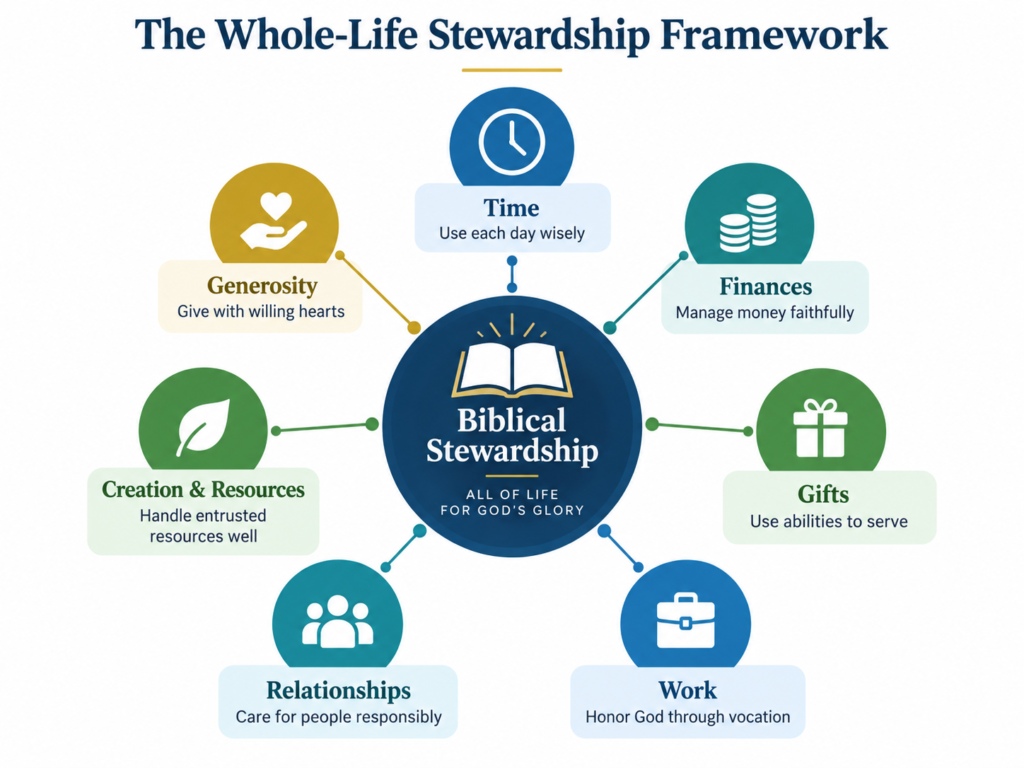
I want to look at stewardship as Scripture presents it: beginning with ownership and then moving into the ordinary responsibilities of time, money, gifts, relationships, creation, ministry, and leadership. For pastors, ministry leaders, and marketplace believers, the question is not simply how to define stewardship, but how that conviction changes the way we actually lead and live.
In This Post
- What Does Biblical Stewardship Mean?
- Stewardship in the Bible: Where the Concept Begins
- 1. Stewardship of Time
- 2. Stewardship of Money and Possessions
- 3. Stewardship of Gifts and Talents
- 4. Stewardship of Relationships and People
- 5. Stewardship of Creation and Resources
- 6. Stewardship of the Gospel Itself
- 7. Stewardship as the Foundation of Leadership
- Bible Verses About Stewardship
- How to Apply This
- Key Takeaways
- Frequently Asked Questions
What Does Biblical Stewardship Mean?
A concise biblical stewardship definition is this: biblical stewardship is the faithful management of everything God entrusts to us — including time, money, abilities, relationships, creation, ministry, and influence — in recognition that God remains the true owner. This biblical meaning of stewardship begins with a specific theological premise: Psalm 24:1 states plainly that “the earth is the Lord’s, and everything in it.”
If that’s true, then no believer is ever really asking “how do I manage my money, my time, my gifts?” They are asking “how do I manage God’s money, God’s time, God’s gifts, entrusted to me for a season?”
For me, that is the heart of biblical stewardship: ownership stays with God; responsibility is entrusted to us. 1 Corinthians 4:2 makes the standard explicit — “it is required that those who have been given a trust must prove faithful.” Not brilliant, not impressive, not even necessarily successful by the world’s measure.
Faithful. That’s the bar biblical stewardship sets, and it’s a bar every believer can actually meet regardless of how much or how little they’ve been given.
“Stewardship begins when I stop asking, ‘What do I own?’ and start asking, ‘What has God entrusted to me?’”
Dr. T. Babu Rao
Stewardship in the Bible: Where the Concept Begins
Scripture Focus
Genesis 2:15 (NIV) — The Lord God took the man and put him in the Garden of Eden to work it and take care of it.
Stewardship in the Bible doesn’t begin with a command about money or even about the church — it begins in the garden, before sin enters the story at all. Adam is placed in Eden not as an owner but as a caretaker, given work and responsibility over something that was never his to begin with.
That’s worth pausing on: stewardship isn’t a consequence of the Fall, a consolation prize for a broken world. It’s part of God’s original design for how humanity relates to what He has made.
The theme carries straight through both testaments. The Parable of the Talents (Matthew 25:14-30) is arguably the clearest picture of stewardship in the Bible in narrative form: a master entrusts differing amounts to three servants, and commends the two who put what they were given to work, while the servant who buried his portion out of fear is rebuked because fear prevented him from using faithfully what the master had entrusted to him.
1. Stewardship of Time
Scripture Focus
Ephesians 5:15–16 (NIV) — Be very careful, then, how you live — not as unwise but as wise, making the most of every opportunity.
Of everything a person is asked to steward, time is the one resource that can never be recovered once spent. Biblical stewardship treats a calendar the same way it treats a checkbook — as something entrusted, not owned, and therefore something to account for rather than simply fill.
In Practice
- Audit a normal week honestly: does the calendar reflect what you say you value, or just what was loudest?
- Protect time for prayer and rest as deliberately as you protect time for productivity.
- Ask what you’re doing that someone else could be trained to do instead.
From the Field
In ministry, I have seen how easily a leader’s calendar can become controlled by the loudest demand. Stewarding time sometimes means learning that availability to everyone is not the same as faithfulness to every responsibility.
2. Stewardship of Money and Possessions
Scripture Focus
Luke 16:10–11 (NIV) — Whoever can be trusted with very little can also be trusted with much… who will trust you with true riches?
This is the area most people mean when they first ask about biblical stewardship, and for good reason — Jesus frequently addressed money and possessions because they often reveal what a person trusts and values.
Among the most searched Bible verses on stewardship of money, Luke 16 stands out because it makes faithfulness with small amounts the actual test of readiness for larger responsibility, not a separate, lesser category of obedience.
In Practice
- Give first, from the top of income rather than the leftovers, following the pattern of Proverbs 3:9-10.
- Keep records and budgets that would hold up to someone else looking at them.
- Treat generosity as a discipline to practice at every income level, not a milestone to reach later.
Why this matters early
This is also one reason stewardship sits close to the heart of the Church-Based Business Accelerator resources we are developing at Provia Global. Financial habits formed early often shape the kind of enterprise a leader builds later.
3. Stewardship of Gifts and Talents
Scripture Focus
1 Peter 4:10 (NIV) — Each of you should use whatever gift you have received to serve others, as faithful stewards of God’s grace.
Peter’s language here is direct — he calls believers “stewards” of their own gifting, not owners of it. Biblical stewardship extends past finances into ability itself: a teaching gift, an organizational instinct, a trade skill.
In Matthew 25, the talents are sums of money entrusted by the master, so the parable should not be reduced to a lesson about natural abilities. Its broader stewardship principle is that what God entrusts to us should be handled faithfully rather than hidden through fear or neglect. First Peter 4:10 separately applies stewardship language to spiritual gifts.
In Practice
- Name your actual gifts honestly, rather than the ones you wish you had instead.
- Put a gift to use in a low-stakes setting before assuming you need more training first.
- Ask who around you has a gift going unused, and create a place for them to practice it.
What I’ve Seen
In leadership development, I have often seen useful gifts overlooked simply because they did not look like traditional ministry gifts. A bookkeeper, a teacher, a technician, or an entrepreneur may be stewarding something just as important to the Body of Christ as a platform gift.
4. Stewardship of Relationships and People
Scripture Focus
Hebrews 13:17 (NIV) — Have confidence in your leaders and submit to their authority, because they keep watch over you as those who must give an account.
Hebrews 13:17 directly concerns church leaders and their accountability for those under their spiritual care. It reframes pastoral leadership: a pastor does not own a congregation but keeps watch as one who must give an account.
By broader stewardship application, employers, parents, nonprofit leaders, and others who hold entrusted responsibility should also treat people as persons in their care rather than possessions or resources they own.
In Practice
- Ask whether decisions about people are made for their good, or mainly for your convenience.
- Build real accountability into relationships where you hold authority over someone else.
- Treat every person under your care as someone you’ll eventually give an account for, not a resource to manage.
From the Field
One of the most important stewardship questions a leader can ask is whether people are becoming stronger under that leadership. Results matter, but the way we treat people while pursuing results matters just as much.
“If our results grow while the people entrusted to us are diminished, we should question whether we have really stewarded leadership well.”
Dr. T. Babu Rao
5. Stewardship of Creation and Resources
Scripture Focus
Genesis 2:15 (NIV) — To work it and take care of it.
Stewardship also includes the physical resources God places in our care: land, buildings, equipment, materials, and the created world itself. For churches, nonprofits, businesses, and families, care for these things is not merely an operational issue; it is part of responsible stewardship.
In Practice
- Avoid treating “it’s replaceable” as a reason not to care for what you use.
- Consider the resources your community already has before assuming you need outside ones.
- Model care for physical spaces — a church building, a shop, land — as a form of worship, not a chore.
In My Experience
The most sustainable local enterprises we’ve supported are ones that started by asking what their community already had — skill, land, raw material — rather than what could be imported and depended on from outside.
6. Stewardship of the Gospel Itself
Scripture Focus
1 Corinthians 9:17 (NIV) — I am simply discharging the trust committed to me.
Paul describes his own apostleship in stewardship language — the gospel itself is something entrusted to him, not something he invented or owns. This is perhaps the highest-stakes form of biblical stewardship: guarding sound teaching, passing it on accurately, and refusing to treat the message as personal property to be shaped around a leader’s own preferences.
In Practice
- Teach what Scripture actually says before teaching what feels compelling.
- Invite correction on doctrine the same way you’d want correction on finances.
- Measure faithfulness in ministry by accuracy passed on, not audience gained.
What I’ve Seen
The leadership training we do across North India returns to this constantly — a gifted communicator who drifts from sound teaching does far more damage than an unremarkable one who stays faithful to what was entrusted to them.
7. Stewardship as the Foundation of Leadership
Scripture Focus
Luke 12:48 (NIV) — From everyone who has been given much, much will be demanded.
For me, stewardship and leadership eventually meet at the same point: responsibility before God. As a leader’s influence grows, so does the range of things entrusted to that leader — people, money, decisions, opportunities, and reputation. Biblical authority should therefore produce greater accountability, not a stronger sense of personal ownership.
In Practice
- Expect more accountability as influence grows, not less.
- Revisit our guide to biblical leadership alongside this one — the two frameworks were built to be read together.
- Ask what would be exposed about your stewardship if your role and resources doubled tomorrow.
From the Field
We’ve found that leaders who practiced biblical stewardship faithfully with small responsibilities rarely struggle with integrity once larger ones arrive — the habits were already formed long before the stakes got high.
Bible Verses About Stewardship
For quick reference, these Bible verses about stewardship explain God’s ownership, our responsibility, and the faithfulness expected of every believer. They are worth memorizing or returning to in a season of decision-making:
- Genesis 2:15 — humanity’s original calling to work and care for creation
- Psalm 24:1 — everything belongs to God first
- 1 Corinthians 4:2 — the standard is faithfulness, not success
- Matthew 25:14-30 — the Parable of the Talents
- 1 Peter 4:10 — gifts held in stewardship to serve others
- Luke 12:48 — greater trust brings greater accountability
Bible Verses on Stewardship of Money
Among Bible verses on stewardship of money specifically, these three come up most often in practical teaching and planning:
- Luke 16:10-11 — faithfulness in little qualifies you for much
- Proverbs 3:9-10 — honoring God with the firstfruits
- 2 Corinthians 9:6-7 — giving cheerfully, not under compulsion
How to Apply This
Biblical stewardship becomes real less through a single decision and more through a habit of asking the right questions regularly:
- If God audited my calendar this month, what would it reveal about what I actually value?
- Is my giving a pattern of faithfulness, or an afterthought once other spending is decided?
- Which of my gifts am I currently burying out of fear, comparison, or false humility?
- Do the people I lead experience me as someone who owns them, or someone who’s accountable for them?
Use these questions in a leadership team meeting, a personal time of reflection, or a family conversation about finances — the goal isn’t a perfect score, but an honest starting point for practicing biblical stewardship rather than just defining it.
Key Takeaways
- Biblical stewardship rests on one premise: God owns everything, and believers manage what’s entrusted to them for a season.
- Stewardship in the Bible begins in Genesis, before the Fall — it’s part of God’s original design, not a consequence of sin.
- The standard Scripture sets is faithfulness, not success or size (1 Corinthians 4:2).
- Biblical stewardship spans time, money, gifts, relationships, creation, the gospel itself, and leadership — not money alone.
- The Parable of the Talents warns against allowing fear to prevent the faithful use of what God has entrusted.
- Leadership is simply stewardship applied at a wider scope — more entrusted, more accounted for.
Growing as Faithful Stewards Together
At Provia Global, stewardship shapes how we think about leadership, sustainable mission, and faith-based enterprise — it’s the theological foundation for our Church-Based Business Accelerator and for the leadership development described on our What We Do page.
We don’t teach stewardship as a fundraising technique; we teach it as the honest starting point for how a believer relates to everything they’ve been given.
If this framework for biblical stewardship resonates with your church, ministry, or business, we’d welcome you to partner with us as we train pastors and marketplace leaders to steward what God has entrusted to them across North India and beyond.
Dr. T. Babu Rao is the Founder of Provia Global and Executive Director of United Gospel Mission. His work focuses on Christian leadership development, church-based training, sustainable mission, and faith-based entrepreneurship. Learn more on our Who We Are page.
Related Reading: For the funding and sustainability side of this same principle, see From Donor Dependency to Sustainable Mission, and for how stewardship shapes leadership specifically, see What Is Biblical Leadership?
Frequently Asked Questions About Biblical Stewardship
What is stewardship in the Bible?
In the Bible, stewardship means managing something that belongs to someone else — ultimately God — on their behalf. A biblical steward doesn’t own what they’re entrusted with; they’re responsible for using it faithfully and will one day give an account for how it was handled (1 Corinthians 4:2, Luke 12:48).
Is biblical stewardship only about money?
No. While money is the area people ask about most, biblical stewardship covers time, gifts and talents, relationships, creation and resources, the gospel message itself, and leadership. Scripture applies the same standard of faithful management across all of them.
Where does stewardship first appear in the Bible?
Stewardship in the Bible begins in Genesis 2:15, where God places Adam in the Garden of Eden to work it and care for it — before sin enters the story. This shows stewardship is part of God’s original design for humanity, not merely a response to the Fall.
What is the difference between stewardship and ownership?
Ownership implies the right to do whatever you want with something; stewardship implies responsibility to manage something well on behalf of its actual owner. Biblical stewardship holds that God owns everything (Psalm 24:1), and people are given temporary, accountable management of it.
Which Bible verse best describes a good steward?
1 Corinthians 4:2 is one of the clearest: Now it is required that those who have been given a trust must prove faithful. A good steward is defined first by faithfulness — not by wealth, visibility, or worldly success.
What are good Bible verses on stewardship to start with?
Genesis 2:15, Psalm 24:1, 1 Corinthians 4:2, Matthew 25:14-30, and Luke 12:48 together give a solid overview of biblical stewardship — covering its origin, its ownership premise, its standard of faithfulness, and its call to use faithfully what is entrusted rather than burying it in fear.